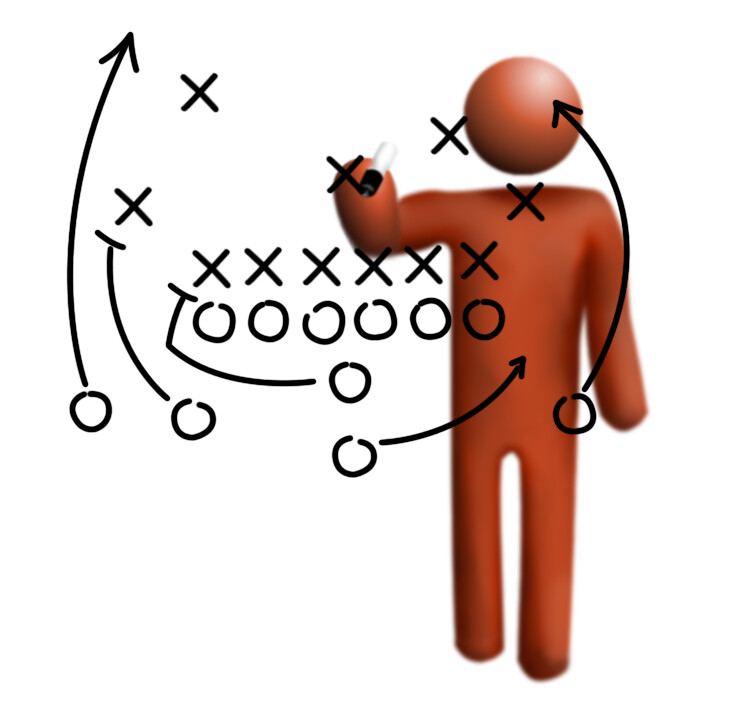
The stereotype of athletics vs. arts is a tired one.
I realize that the tension is present in some schools and communities, but I believe it is time to move past that. If education is truly for the benefit of the whole child, then creating a culture (in school, at home, in the neighborhood, wherever...) where a student's participation in athletics, arts, and academics is paramount.
I am fortunate to be in a school district where that idea is a reality. There are great people in the athletic department and administrative chairs who see the value in what we do in the arts programs. I frequently connect with coaches to ensure students can be on stage and on a team. Many of those same students excel in Honors and AP level coursework, too. However, it takes work. It requires conversations and sacrifice and recognizing the common ground between us. In my school, we've done this through conversations (largely on social media, of all places) about leadership and coaching and the values we seek to instill in our students. (I've posted about my perspective on what school theatre is for here and here).
Whether you have the privilege to be in an environment like mine, or struggle in a place that does not see the value in arts education, I encourage you to reach out to community. Ask questions of stakeholders and detractors. Identify areas of common ground. Use your advocacy tools to demonstrate that value. Nothing is a panacea, but is a place to start.
I'm curious to hear from you. What are relationships like where you are? How can we work to build understanding and connection among programs, activities, and factions that are traditionally viewed as opposed to one another?
When school went virtual last March, our winter musical performance was put in hold. This happened everywhere, of course, but we were hit especially hard because the call to postpone came just minutes before the end of the school day - just 3 hours before students would return for hair & make-up on opening night. The experience resulted in an incredible story of resiliency starring my students, but that's for another time.
Without a live event, and the uncertainty of what lay ahead, the creative team began exploring options to showcase the students' work in another way. We considered a scaled-back concert, outdoor performances, and inevitably some kind of stripped-down streaming presentation. Circumstances kept changing and, unfortunately, we ran out of time. The show was cancelled and in deference to the seniors, we decided not to repeat the show again the following year. One thing haunted me throughout the experience - if we had just recorded one dress rehearsal, we could have worked with the licensing company to present it online. Lesson learned. I would not make that mistake again.
This past winter, we forged ahead with the goal of a live performance, but with digital/streaming as a backup plan. I recorded something at least once every week as a way to document what we were doing behind the scenes and to get the audience acclimated to watching online... just in case.
We had plenty working against us, both Covid and non-Covid related. Eventually, the decision was made to film the show and stream online. The final two weeks were a unique experience that none of us will forget. While the result wasn't we wanted, streaming the show had plenty of positives. For one, we were able to have a show where we couldn't last year and likely wouldn't under the circumstances we faced. Also, being online expanded our audience beyond the doors of the auditorium to reach far away relatives, friends, and other theatre people who would not have seen the show live. Plus, the students had the unique experience of watching their performances "in real time".
On September 13, we will be 18 months removed from the first day of Covid quarantine. That is a long time to endure without an art program and I saw our survival in the push to keep doing something. In the professional field-at-large, there are organizations who found ways to continue producing their work digitally while others have struggled to survive. I get it. Theatre is live performance and doesn't always translate well to the screen (an irony that my middle school students pointed out when we were virtual), but surely that is better than nothing.
I've seen concern from some theatre artists via Twitter that some organizations and communities are moving away from digital presentation as buildings begin to open up again. It is surprising to see that given how successfully companies like the National Theatre in London, among others, had done so. I realize that the collaborative nature of theatre and the copyrights, licenses, contracts, and other elements provide a hurdle as currently constructed. Surely, with digital technology so prevalent and easy to access we should continue to explore ways to not only make the art accessible during times of inaccessibility, but more equitable, too.
PS - My assumption is that visual artists and organizations fared better during quarantine as digital is inherently visual. The art teacher at my school did an excellent job getting her students' work out online even though there was a large learning curve for her to do so). However, that is not my field and I really don't know the realities of the visual art world and would love to hear from some of you about that!
Two years ago, I shared this quote with the TYA class and it became a touchstone for students throughout the year. With Mr. Rogers as our guide, we began to feel more comfortable with the idea of exploring life questions with young people. I did not think to include it in class this past fall, but the sentiments permeated the course and the thoughts and projects generated by the students were similarly contemplative of what can be explored through children's theatre.
March 12 is a dubious date in my school theatre program. There are two reasons for this distinction:
March 12, 2020 - opening night for our winter musical, Into the Woods, which was postponed due to Covid just minutes before the end of the school day
March 12, 2021 - the final day of filming our Covid-restricted winter musical, Disney's The Little Mermaid
There may be many things to say about redemption and tenacity when you look at those two dates together like that. It was certainly the message that I repeated to the students as we pushed toward the end of filming through a variety of Covid-, and non-Covid-, related delays and hiccups and issues and roadblocks. But what I think is more interesting, and likely more important, is the influence those experiences will have on the students who lived them. The past two years have been difficult, which makes it easy to view them negatively; however, there is strong positive flip-side to that story. I'm curious how it will be perceived by my students and how it will play a role in their futures.
That leads me back to a question that I love to explore: "what is the role of theatre in schools?"
School theatre saved my life; there are others who have told me the same thing. Participation in theatre programs has benefits within a student's future artistic life as well as within the "real world". That has been seen in research published in Youth Theatre Journal and in my own doctoral dissertation. Now I'm curious to learn how school theatre programs can play a role within the larger school community. What is the perception of these programs from participants and non-participants? How do school theatre programs influence the overall function of a school? What happens with theatre programs are not present, or suddenly seek to exist? How about when they are first built, or "revitalized" after a significant absence?
Looks like I have some reading to do... and surveying my students for their stories... uh oh! Is this another research project in the works?
We had quite a time in the classroom this past week. 1/3 of the musical cast is now in quarantine due to positive Covid contact. They won't return until two days before our first dress rehearsal. We will now shift our plans to a fully filmed performance, which may actually take some pressure off of the cast.
In brighter news, two students in the Playwriting class received Honorable Mentions for their original, one-act plays. It is awesome recognition of their creativity and the hard work they put in to the piece. The students all loved the class so much; it was great to get their feedback about it at the end of the class. This is some fun icing on that cake!
Watching the Macy's Thanksgiving Day Parade yesterday sparked two thoughts for me:
how traditions are often refreshed and revived for the better
just how resilient we can be in times of difficulty
I want to start with that last one because it sticks with me in a new way this year. It is easy to get caught up in how difficult things are in any given moment. The last eight months have certainly been awful with Covid ravaging around the globe, but let's notice how well people have been adapting and, in many cases, thriving, in this environment. I have an example specific to the parade, but let's first look at my field of educational theatre.
As you may know, school theatre programs were unceremonious and suddenly shut down in mid-March as schools and municipalities were forced to close to prevent the spread of Covid. My students and I were informed of the postponement of our production of Into the Woods just minutes before the end of the school day on opening night. Delivering that news to the cast and crew on that day was the most difficult thing I've ever done. However, those students were so incredibly resilient. We had the opportunity to get back a significant portion of our rental costs for the backdrop and costumes if we boxed them up and shipped them back THAT DAY. A significant number jumped right to the task. That act of strength in the face of heavy disappointment has allowed us to secure the rights to a bigger show at a very reasonable cost this year. We are thankful for Charles H. Stewart Backdrops, The Costumer, and MTI for their flexibility throughout all of that last year. It leaves us in a great position to do whatever possible to put up a show this spring.
I share that story to highlight how school theatre programs, as well as local and regional theatres, across the country are working extra hard to create opportunities for their students and communities to gather safely and experience the art of live theatre. Many schools are filming their shows and streaming to paying audiences (our likely process this spring). In some locations, even in my home state of New Jersey, it is possible for small, socially distanced groups to attend live performances in the theatre spaces... something that Broadway cannot allow. Yet, all this time, there is such a heavy focus on how Broadway is closed down. We are out here making theatre happen and I strongly encourage those craving live performance to support their school theatre programs and community playhouses!
There will be a lot of school theatres breaking with tradition in order to mount productions this year. As I recently told my students, the one thing we can be sure if is that we can't be sure of how anything will ultimately go. Macy's and NBC found a way to break with tradition and give us a refreshed and captivating Macy's Thanksgiving Day Parade yesterday. While it was odd to see the parade without people lining the streets, and the daylight and clear weather in some segments were obvious signs that some portions were previously recorded, the result was exciting! I particularly enjoyed the inclusion of the Land Acknowledgement and Wampanoag Blessing and the inclusion of groups from some of New York City's other parades. This was a great way to liven up the event and give us something that we don't always get to see. I hope these can become regular segments of the parade and that Macy's & NBC can further explore avenues to bring in performances and groups that aren't commonly seen on television. Frankly, they could cut back on more of the pop stars and celebrities in order to do it. Maybe adopt more of a variety show type atmosphere? That's what makes shows like NBC's America's Got Talent so appealing. Where else do you "fringe" performers like spoken-word poet Brandon Leake, ventriloquist Darci Lynne Farmer, or dog shows like Olate Dogs, celebrated so publicly?
In the end, I'm grateful to have a new perspective from which to view my own work and popular entertainment in general. The holiday season is a great time to dream about new beginnings in the New Year. What great examples for me - and for all of us - to embrace as we continue to move forward throughout it all.
This weekend wraps up the summer edition of the Conversations Series on the Young Playwrights Guide YouTube channel. I had such a great time connecting with the artists & teachers with whom I worked on the NJ Young Playwrights Festival. Their stories and insights are excellent resources for not only youth creators, but many of us looking to reconnect with and rekindle our passion for the art form. Please head on over to the YP Guide YouTube channel to check out the videos; please reach out to the artists interviewed, too. They are excellent people to work with!
This summer I read the book Grit: The Power of Passion and Perseveranceby Dr. Angela Duckworth. This was an enjoyable read with easy to follow concepts and relatable examples. Within the first two chapters were ideas that I see as easily adapted to the theatre classroom or after-school program. The most exciting part of the book was a later chapter that included an entire section devoted to how after-school & extra-curricular activities are the best environment for students to learn and develop perseverance. This perseverance is what Duckworth defines as "grit".
Expanding further, Duckworth defines grit as "passion and perseverance for long-term goals" ("What is Grit?"). Grit is purposeful determination aimed toward achieving higher-order goals. Grit is what Duckworth's research shows may be the greatest indicator of future student success.
What incredible supporting evidence for my experience that I learn more about how well a student will do in a theatre class, or a school production, based on their demeanor and conversation in an audition or rehearsal room. Often that tells me more than "talent". In fact, while Duckworth identifies talent as the first step toward developing grit, effort "counts twice" in that pursuit.
This is explained in Duckworth's achievement theory, which works like this:
talent x effort = skill
skill x effort = achievement
Based on this theory map, talent is the first step toward skill development, which is necessary for goal achievement. It isn't enough to have talent - one must apply their talent through effort. Further effort, bolstered by subsequently developed skills, brings achievement.
This makes a lot of sense. How many times have we theatre teachers and directors - and I would assume coaches in school and youth sports - seen a child with talent who did not realize their full potential due to a lack of effort? However, there is one slight adjustment I might make to the achievement theory above. I don't know that talent is an essential first step toward goal achievement. Perhaps "interest" is all that is needed?
Let's consider "talent" as a natural skill that gives a person a head start toward achievement. As explained by the theory, a talented person still needs to put in the effort to accomplish the end goal. However, those who lack the same "talent", but posses a strong interest in goal achievement, can still get there through effort. It may not be as easy, but it is certainly possible.
That is an important idea to keep in mind when conducting our classes and leading our productions. In fact, I envision that first level of the Achievement Theory as the classroom and the second level as the production. Skill can certainly be developed through effort in the rehearsal process, but the classroom provides time for individual instruction and for focus on specific skill development that cannot always be achieved in the rehearsal room. It is an interesting model that I am eager to bring to my high school classes. I'd be curious to hear how you view this approach and whether or not it may, or has, worked for you.
"Revise and Resubmit" is not exactly the comment that a writer wants to receive after submitting a manuscript for publication. I've had my own experiences with this over the summer that I am still trying to parse out (thank you, Reviewer #2), but it helps me to remember that revision is a process of improvement. It is similar to the Stoics' reminder that "the obstacle is the way" and that every challenge, or difficulty, offers an opportunity for improvement.
I've done a lot of curriculum writing and lesson plan revision this summer. Most of this is for the theatre classes in middle school and high school (some are new, but some is for the potential need to adapt to online learning again). This week, I have turned my attention to the TYA course that I teach for the Program in Educational Theatre. I've been teaching this class since 2014 when I inherited it from a long line of influential people in the field: Dr. Lowell Swortzell, Laurie Brooks, and Jonathan Shmidt Chapman. The course structure has evolved over time and I have continued that tradition by adapting Jonathan's syllabus and making adjustments and tweaks to the course every year since.
About two years ago, I incorporated the 25 year anniversary anthology from the New Visions/New Voices Festival at the John F. Kennedy Center for the Performing Arts in Washington, DC. New Visions/New Voices is one of three major new play development programs in the field of TYA currently in existence in the United States (along with Write Now and NYU's New Plays for Young Audiences Series). The anthology was a way to focus on current scripts while emphasizing the importance of new play development in the field. Perhaps most importantly, using the anthology reduced textbook costs for students. The NV/NV plays are serviceable and the last two classes have enjoyed them; however, one of the strongest suggestions received from the classes was a desire to delve into even more current and relevant scripts. I have made that my goal while preparing for the fall.
When constructing the syllabus, it is also important to recognize the variety of students on the class roster and their varied perspectives. The class is typically made of students from freshman to doctoral candidates, Educational Theatre majors to performance majors from Tisch, as well as students from outside the arts who are interested in exploring the world outside of their math and business majors. The students are, or plan to be, theatre praticioners, educators, and producers, or are simply interested in story from a teller and/or audience point of view. All of these perspectives inform my planning and I plan to balance the reading list with scripts that are of historical significance to the field and that are often produced in professional venues and schools. The EdTA 2020 Play Survey was helpful here. I am including some of the titles on these lists with those from the NV/NV anthology.
One text that has not changed from my first courses at both Manhattanville College and NYU is Moses Goldberg's collection titled TYA: Essays on the Theatre for Young Audiences. This is an EXCELLENT book that I could not do without!
I am excited by this changes and look forward to exploring the works with a new group of students and to seeing and hearing their reactions and insights. There are still some areas of the field that I can't quite cover in the time provided for the class. I plan to ask students to explore those topics in their midterm project and see what may come out as the most important aspect to incorporate in the revision for next year.
After a great, yet unconventional school year, I am eager to get back. This is the first summer where I know my course load and the first time that I can go into September with plans in place. Previously, I've either been hired just before school began - or with the school year already in session, left in the dark about classes until arriving at school for the first professional development day. I'm further ahead in my planning than in those situations, but I'm getting ready with such a large question mark about how exactly our hybrid school model will pan out. That is the case for every teacher in America who hasn't yet begun school - it is frustrating, but necessary.
The biggest question right now is what form the winter musical might take. Choices are limited because of the need to secure streaming rights for the performance. I do have a show in mind and am eager to start planning because it will be a big undertaking if we can perform "normally" - we have no idea if we will be able to bring an audience together in March. I know that March is months away, but I always start planning this far out.
It's the inertia that is so frustrating at this point. Planning and preparation is necessary, but I don't want to waste that precious time doing things that may be unnecessary depending upon the circumstances.
Remote learning was challenging. That's no surprise and while each stakeholder has their own reasons why, we can all agree that it was a challenge. But from my perspective as both a teacher and a parent, it was a challenge well-received and one that - after a series of significant hiccups - went pretty well.
That's not a consensus view, I know. Plenty of people want school buildings to open up rather than struggle with the challenges of remote learning again. I miss working directly with my students and want to return, too. I'm all for a return, provided that we can do so safely. The rising numbers in my neck of the woods is troubling and hopefully we can get things under control before September. I'm also fortunate that my school district is starting a week later than most in order to finish some major construction projects at the middle school/high school complex. We are six weeks from the first day. The district is also planning very thoroughly and the plan currently under consideration is sensible and oriented toward safety for us all.
Whatever the return to school buildings (NOTE: not to "school" as some people will claim. Schools didn't close in March, the buildings did. We all continued with school even when working from home - an important distinction)... the return NOT be a return to normal. I think that under it all what we really want when talking about going back to school is a return to "normal". That leaves me in an interesting place where I am planning for something that is not quite clear, or understandable. But that's all things, isn't it? No matter how often we've experienced a certain something, or know what that something has been, it is never the same one year to the next - not even one day to the other. That idea is important to keep me from overthinking things. I'm going to plan for my classes and be more open than ever to the unknown of our hybrid classroom/remote learning model.
I'm excited to return. It's all I can think about and I'm doing my best to temper that excitement so as not to overwhelm my supervisors with questions and ideas that need to take a backseat to the pressing details of just how we all get back into the building safely.
That excitement comes from a love of my work and is further fueled by frustration. We had incredible excitement and momentum surrounding the high school winter musical and the new Theatre classes at the middle school. I know the students feel that frustration, too, and suspect that it will fuel them as it does me. Above all else, this whole experience reminds me the importance of grit and resilience and the need to just keep swimming, especially when the current gets rough.
This week, I return to Monmouth County Parks to teach a newly developed "Theatre Design" camp for students in grades 6-8. I worked with the parks last year on the "Theatre Techie" camp, which had to be revamped in lieu of the current Covid-19 restrictions. It occurs to me that this will be my first time in a classroom setting with students since my school shut down on March 12th. I will also have one of my middle school students in the camp. They were in my 4th marking period class, which only met online, so while they were a student of mine for 4 weeks, tomorrow will be the first time that we meet face-to-face. Crazy!
I'm looking forward to the program as it draws from some of the design elements that I brought to my general Theatre class at the middle school this year. However, with design as the focus we can spend a LOT more time on it than we did before. We will do some text analysis, sketching, modeling, revision, and "building". The end goal is for students to create a model set out of foam core. This something that I've seen done, but have never tried on my own. I'm curious to see how it will work and look forward to creating along with the students. More to come!
This is my third consecutive year teaching in the classroom (not counting the one year immediately after grad school). My journey to this work has been anything but traditional, which I think is one of the biggest benefits that I bring to the position I am in today. And not just content-wise as a theater teacher, but because of what I learned about audience engagement. My daily audience is my students; however, they're not the audience to whom I'm referring. Student engagement is important, of course, but so is engagement with the families and community outside of the school.
Audience engagement is important inside and outside the classroom
Dr. Joe Sanfelippo is the superintendent of Fall Creek School District in Wisconsin. His One Minute Walk to Work videos are a great resource for educators, but also a master class in leadership. In a recent Tweet, Dr. Sanfelippo talked about regularly connecting with parents, not just in the moments where we need them, or need to inform them. I've recently found how important that part of the job is. In the short time I have been in my current job, a number of parents have told me how much they appreciated hearing from me. Building those relationships is important for a child's education. I've taken steps this 3rd quarter to reach out to parents more often, but also emphasized the idea that Theatre is a communication between actors and audience. That skill is at the heart of my curriculum and surprisingly something in need of development in our society of advanced technology meant to bring us closer together. Just two weeks in now and already it seems as if students are creating with each other quicker and with less hesitation than in previous quarters. I hope this will lead to deeper collaboration by the end of our 10-week session. At the high school, I hope to achieve my goal of expanding the student theatre program's social media presence will have long-term benefits. Our first gauge will be how well increased communication and engagement works with regard to ticket sales for the upcoming musical (Into the Woods - March 12, 13, 14). Perhaps from there, a link can be made to the transferable marketing skills developed in the theatre classroom.
"You can entertain younger audiences while still playing to adult viewers [...] you can get away with being a little dangerous, provocative, or just plain deep if you did it with a smile on your face and remembered that entertainment always came first. When done right, it's possible to be silly and subversive at the same time."
Receiving wisdom from Lowell Swortzell Rehearsals for Lucky Peter's Journey February 2000
A few months ago, I was cleaning out an old filing cabinet in the education office at Writers Theatre. In one drawer was a series of teaching artist files and resumes from actors/directors with whom we've worked in the last 20 years. One of the last folders in there was mine, which contained my original letter of application and resume. It was remarkable to look back at some of my earliest work in the graduate program at NYU, particularly two TYA directing projects: a staged reading of Lucky Peter's Journey adapted by my mentor, Lowell Swortzell, and a devised, collaborative piece called The Greenwich Village Project.
Clearing out some old filing cabinets in my office at the theatre today and found many articles, reviews, and folders with quotes that sparked my first thinking about the direction of the eventual dissertation. Here's one from the late Dorothy Heathcote that will bring some new energy to my theatre classes in the year ahead:
"You can do things because you self-consciously feel a fool. But in the theatre, you do things because you are conscious of self for the audience. You GIVE to the audience. You don't take from the play."
There is a notation that this statement came from a master class given by Heathcote to students at NYU. I believe the comment was recorded either in an account of the event by Cecily O'Neill (not sure if it is this book, or in other writing), a video of the workshop, or Theatre for Change by Landy & Montgomery. I can't source it to any of those at the moment, but I imagine you can find it - and similar wisdom - in any of those locations.
Image: "Coaching" by Shane McGraw Accessed at flickr.com Unaltered / License link
A few months back, I attended one of my last doctoral seminar classes. In fact, if I remember correctly, it was two weeks after successfully defending the dissertation, which meant that I was no longer required to go - a detail I did not know until I tried to sign in and found my name wasn't on the roll. However, it was good that I was there to hear a research topic proposal presentation that I have been thinking about ever since.
Unfortunately, I no longer have the proposal paper and cannot rightfully credit the person doing the research. He was looking at a music education pedagogy with similarities to athletic coaching. I don't remember all of the specifics, but I do remember being struck by how well this seemed to adapt to theatre education at the high school.
Then, this evening, I was listening to The Art of Manlinesspodcast while ironing clothes for the week. This particular episode (#405) was a conversation with a man named Sam Walker who has written a book called The Captain Class about how the captains of some of the most dominant sports teams are often not the best players, celebrity athletes, or known names. I didn't get far enough into the episode to get into the heart of the findings, but generally Walker's book discusses common components of these leaders' styles. That got me thinking about the research topic and how I might apply it to the high school theatre program where I teach.
I would like to take some time this summer to read about coaching psychology and methodology and see how it can be applied to the theatre program as a whole. I see the program defined by both the classroom instruction and the practical application of that work in the school productions and other performance opportunities (competitions, festivals, etc). How can athletic training be brought into both of those areas to improve my instruction and student learning? In what ways are these two environments similar and different? How much practical training is "enough" and how can psychology and education about training be implemented? How can I teach leadership in an arts-based curriculum?
Lots to learn. Looking forward it learning and putting it all to use!
Theatre In Our Schools Month kicks off today and for the first time I am participating as the leader of a school drama club. Our state Thespian chapter shared a series of prompts for the occasion that were created by Thespian Troupe #5840 at Gloucester County Institute of Technology. I have adopted and shared these with the community at Lacey Township High School with the goal of getting as many students, teachers, staff, and community members involved in celebrating. While I look forward to seeing what they share, I am also excited to share a few things myself, particularly today with the prompt:
“Favorite song that you have performed or want to perform”
I am a huge musical theatre nerd. The history of the genre is fascinating to me and I have also been known to burst into song on occasion. This is something I usually try to keep under wraps, of course (unless I’m teaching upper elementary or middle school students whose appalled amusement is quite enjoyable), so it may come as a surprise to some reading this blog (and not quite a surprise to others, like those who live in my house).
Finding just one favorite song for this prompt is tricky. So here are a few that might fit the bill:
1. “Oh, What a Beautiful Mornin’!” from Oklahoma!
I’ve written about this song before and how much I like Hugh Jackman’s performance of it. This is an easy song to sing and I think I manage it pretty well in the car. Not a role I’d ever want to play, nor is it one in which I’d be cast. The character’s name (Curly) isn’t accidental!
2. “If I Can’t Love Her” from Beauty and the Beast
Similar to “Mornin’”, this is a great song to sing and way back when I was an auditioning actor (as opposed to a working one), this was one of my go-to songs. It fit my range well and the emotional depth of the song is moving. Terrence Mann sung the song well, but Josh Groben's pretty good, too.
3. “A Little Priest” from Sweeny Todd: The Demon Barber of Fleet Street
Sweeney Todd is my favorite musical. It has all of the Sondheim qualities to enjoy and is an amalgamation of performance styles that feel appropriate to, if not actually of, the Victorian era in which the story is set. “A Little Priest” is a good music hall / vaudeville routine that swings across the emotional and psychological spectrum of the murderous, vengeful Todd. I have never played Sweeney Todd - and would gladly welcome the chance to do so -, but did perform the song during my freshman year of college. In my undergraduate program, senior Honors students research and present a performance thesis at the end of the year. I was cast with three other students to perform a musical revue that included “A Little Priest” and the preceding “Epiphany” (another excellent song).
Click here to see Angela Lansbury & George Hearn perform this song.
4. “Part of Your World” from The Little Mermaid
That may seem like a goof, but file this song under “favorite that you want to perform” for me. A few years back, I was teaching a playwriting residency to a large group of 4th and 5th graders. We were talking about how sometimes a play is fueled by a character who wants, or needs, something that they feel they must have. This song popped into my head and I went with it... actually, I began singing it… and it worked. Ariel has everything she could possibly have, but what she really wants is a whole world away from her. We all feel like that at some point in our lives. It is also a good touchstone for younger audience members from elementary school to high school who can’t wait to get older and get out into the world to see what is beyond what they’ve always known.
Obviously, I will never play Ariel, but if there was ever a “miscast” performance like they do at MCC Theatre’s annual gala, this would be a song I’d like to sing. Or perhaps even “Never Go Back to Before” from Ragtime. That’s a good one, too.
5. "Lily’s Eyes" from The Secret Garden
When this show opened on Broadway, I fell in love with it to the point of jealousy when my sister received a copy of the novel by Frances Hodgson Burnett. We lobbied to produce the play in college and when it was chosen for the season during my junior year, my friend Lou and I auditioned with “Lily’s Eyes”. We were cast in the roles of Archie & Neville Craven, respectively, and sang this song quite often. I couldn’t get enough of it. The song still moves me today and is absolutely the most favorite song I have performed.
This past month I had published two articles about the growth of young playwrights programs in the United States:
The first is an encyclopedia-style entry about the burgeoning regional programs in the late 1980s, which is published as part of a crowd-sourced timeline celebrating the 30th anniversary of Youth Theatre Journal. You can link to the article here.
The second is an article about the current field of young playwrights program that draws from data I have gathered in creating and updating The Young Playwrights Map. This is published in the NYU Program in Educational Theatre online journal, ArtsPraxis, and can be found here.
I am excited to share this work and to document the tremendous field of playwriting programs for youth that are present in this country. Looking forward to wrapping up my dissertation exploring the impact of these programs and to continue to advocate for the unique opportunities and experiences provided within this field.
"Thank you for inviting me here today to celebrate with you the induction of these young people into the International Thespian Society. Though I’ve been involved in the theatre since the age of eight, I have never had the privilege to take part in a program like this and I am honored to be a part of the ceremony today.
"It is fitting to celebrate students’ work in theatre with a ritual like this as it is in ritual and storytelling that theatre has its origins. Our earliest ancestors gathered around the fire to hear a shaman incant tales that demystified the unknown things around them and within. These stories became the basis of ethics and religion and education as our ancestors evolved from those earliest days to the present day. Throughout that history, we humans continued to gather to tell and hear stories much as the ancients did, but with new technology constantly upgrading the meeting places and advancements in philosophy and training reshaping and refining the storytelling methods.
"It is remarkable to think how important theatre must be to withstand such a span of time. The Roman poet Horace may have put it best in the Ars Poetica, his study of poetry and drama, when he said that effective theatre must be both dulce et utile: meaning sweet and useful. To put it another way: entertaining and educational. The theatre has always served both purposes though at times it may have drifted toward one end of the spectrum, or another. In our modern age, with the spectacle of falling chandeliers, rotating barricades, and pop music reviews, we swing a bit more toward the entertainment side of of the spectrum where it can be difficult to recognize the educational importance of the art form. At times, those of us in the theatre struggle to prove our worth in a world increasingly obsessed with higher numbers and 'better' results.
"Yet it is also in this same era that serious research has explored the impact of theatre participation and education on students’ academic and creative development. A few years ago, James Catterall, a professor of education at UCLA, concluded his 12-year study of visual and performing arts education at the secondary school level by finding that 'sustained student involvement in theatre arts associates with a variety of developments for youth: gains in reading proficiency, gains in self-concept and motivation, and higher levels of empathy for others' (p. 2). Additionally, in a 2012 study, the National Governors Association Center for Best Practices surmised that the arts and culture sector can play a major role in the revitalization of local economies through 'community revitalization and the development of a better prepared workforce,' among other things. (p. 5). Education and creativity experts like Sir Ken Robinson speak of the necessity of arts education to ensure that our children have the creative capacity to survive and succeed in whatever future the remainder of 21st century may reveal.
Beyond these intrinsic benefits there also is much that is learned in the way of Core Curricular Content knowledge through the research, dramaturgy, and development that goes into the preparation of a theatrical performance. In order to prepare for a role, an actor studies the text and subtext of a character’s written dialogue and the historical and social contexts that impact his/her actions and language. Similar work is done by a director and a designer to bring the details of the play to fruition; not to mention the playwright who creates or recreates that world in the beginning. How many of you know more about our world after putting on, or seeing, an historical play?
Theatre helps us to better understand ourselves, too. For example I remember being an 8-year old boy sitting on the floor of the school gymnasium completely engrossed with an assembly given by a local opera company. At recess, I grabbed my four-color, retractable ballpoint pen to quickly record everything I had seen or heard at the assembly. I even cast my friends for a production that, unfortunately, never made it to my planned playground performance. My love of theatre was born that day and I began to soak of every experience I could have backstage and onstage and in the audience. Through the stories I experienced I learned about the world and imagined myself in it. This brought great joy and entertainment, but also a feeling of family as I worked with a variety of people in each production. That sense of belonging did more for me than I could have ever imagined at the time as it also gave me the necessary encouragement and validation I needed to get through future years complicated by a rare autoimmune disorder and a resulting lack of self-esteem. You may have similar stories of learning and growth that stem from your own interactions with theatre, or those of your friends, or children.
Which brings us back again to the theatre as a place for telling and hearing stories. With all of this learning going on, how nice that we are able to do it in the midst of the fun and excitement of a show! For let’s not forget the dulce in Horace’s description of the theatre: that its benefit is not just to feed the mind, but to please the soul as well. Congratulations to all of tonight’s inductees on their accomplishments in these pursuits. May all your future endeavors be sweet and useful. Thank you."
Photo of Bic 4-Color Retractable Ballpoint Pen from Staples.com


 '
'