Showing posts with label teaching theatre. Show all posts

Tuesday, June 21, 2022

And... scene!

from the Holmdel Theatre Guild
Today is the first day of summer and the last day of school. A half day. I've been home for 90 minutes and am already antsy and looking for something to do. Those of you who know me probably expected that. Even though I plan to rest this summer, I'm not one who is really able to rest. And there is plenty to do - a whole summer's worth, in fact. But I'm trying very hard to take the second half of this day - and the whole day tomorrow, if possible -  to not do work. Writing seems to be a happy medium.

This year was a long one and like many other educators, I'm relieved to reach the end. This was a hard one. In some ways, this year was more difficult that the last two with Covid, but it ended on a relatively high note. Lots of yearbooks signed. A couple of student requests for selfies. A few gift cards. And one student who quietly asked me to sign her book and then, when I was finished, quickly told me I was one of her favorite teachers before she ran off and away from what was clearly a moment of vulnerability for her. As I told the two other students standing there with me, "that's why I like the last day of school".

Middle school graduation was last night and high school graduation is tonight. I view this last day in the same lens that many graduation speakers tend to take: Every end is a new beginning. There will be time to further reflect on the year and make adjustments for September. I have a pile of data from student surveys to peruse; oh, and a new classroom space being built! (More on that as we get closer). For now, I will try to take it easy. Maybe read a book, or play a game with my kids. There's so much more time for that now. The work will be there for me on Thursday.

Happy summer, everyone!

Wednesday, June 15, 2022

Remember to Have Fun

Today, I met with a middle school class that is one of the most energetic I've had this year. They were working in randomized, small groups on a "final" performance project that ended with about 8 minutes left in the period. As I sat in the back of the auditorium marking the final group's rubric, the class - all of whom were sitting together in the first three rows - began to laugh and joke around with one another. A few students began performing on stage. They were doing funny bits, acrobatics, singing... I was in awe. A few turned around and asked if I was okay. It seems that I was sitting there rather comically with my mouth open just taking it all in. I walked to the front of the room as the circus died down and told them that was the most incredible eight minutes I'd witnessed all year. A few of them wondered if they were in trouble. Quite the opposite, I told them. I was just enjoying watching them let loose and have so much fun with one another.

I try to keep the classroom fun. I'm lucky because theatre is built to be that way, but sometimes things can get a little too serious, or a little too formatted. Their display was a great reminder that sometimes we just need to let loose and have a good time... especially in school.

Sunday, June 12, 2022

Winding Down

Photo by Richard Pasquarella on Unsplash

Seven days more until summer.
June 21. Coincidentally, that is our last day of classes. I am especially looking forward to this one and to having time over summer for the preparation of new programming and to revise curriculum for 2022-2023.

These last days of school are always interesting. With middle school, it's about keeping things "normal" while battling the students' ever-growing feeling of summer freedom.

In the high school, there's more a sense of winding down. As tests and projects come due, we all breathe a bit easier and reflection takes the stage. I love sitting with classes and asking general questions: How are you? How did things go? What worked? What didn't? What would you like to see/do next time? What can we do better?

These conversations over the last five school days brought excellent ideas and suggestions from students that I can't wait to put into action. It's great how this work always comes back to the core finding that has become my mantra: "take them seriously". They've begun taking themselves seriously, too, and the awakening that has begun is going to be fun to watch develop in the next school year!

Sunday, February 20, 2022

The Gifts of Planning & Collaboration

This school year presented a unique opportunity to direct plays on both sides of the MS/HS complex. At the end of January, we closed the middle school musical production of Rock of Ages: Youth Edition while the high school production of Oklahoma! was in full swing. Having collaborators on both projects made this a smoother transition than one might expect. I am grateful for their flexibility while I swung back and forth between the two projects.

It seems this arrangement may continue into next year with additional directing opportunities. It sounds like a lot of work (and it is), but an incredible way to further develop the theatre programs in both schools. An added benefit will be the time I've been given to plan.

Choose any number of quotes about the importance of planning here. The most difficult challenge in the process this year was being handed the reigns to the middle school shows a month into the school year. Again, having a collaborator made that process easier. The addition of time gives us the ability to reflect on this past process and to make adjustments for the year ahead. I already have a few ideas in mind and am excited by the possibilities.

It is a unique arrangement to be in charge of theatre programs at two schools. Perhaps some of you reading this post may have experience with this. Any suggestions or advice you may have are greatly appreciated!

Sunday, January 9, 2022

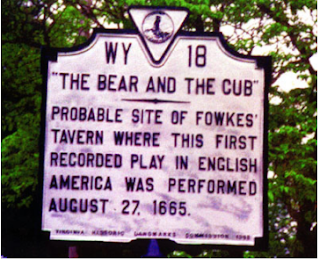
Theatre History: What was the "first" play in the United States?

My first year teaching middle school theatre, I was surprised by how few students understood that Theatre has ancient roots. In their defense, the history of theatre is not a major topic in elementary social studies classrooms, if it is even mentioned at all. It make sense that the students' frame of reference would be what they have experienced for themselves.

I love theatre history and it was a great pleasure to bring some of that knowledge to the curriculum in subsequent years. They are genuinely shocked by how old the art form is and how widespread the practice of performing stories for an audience has been across the world. What surprises them even more is that some historical "facts" can be disputed. This is particularly so when we talk about historical "firsts".

historical marker in Accomac, Virginia

For example, as a conversation starter I will sometimes ask: "When was the first play performed in the United States?" We discuss their answers, which they are allowed to guess or Google. I often get the following:
Then we consider that the United States has only been an name used for a particular area of North America since 1776. Of course, that geography has changed in the 245 since. We can then go further to consider what play may have been the "first" in the American colonies. But, then again, people have been on that land before the Colonies were formalized, even before the colonists reached the land. And we typically think of those colonies in the context of the 17th and 18th century. Did the Vikings perform plays in North America? In what ways did the indigenous peoples perform for one another?

It is a bit more than they bargained for, but in an elective class that the majority of students present didn't elect to take, it is an important idea to consider. Our definitions, our ideas about what is important or good or fact, may be limited by the context in which we search, or exist. It is a great way to get students who are used to thinking academically (not necessarily creatively) to realize that things can go in many different directions. That's an important understanding in a classroom where creativity and imagination are essential tools.

Friday, January 7, 2022

Finding Purpose in the Pause

Pauses and stops are disruptive by nature. What if we saw them as opportunities instead?

This morning I woke up to the second snow day of the week. While it is nice to have a more relaxed day at home, it also means rescheduling and restructuring lesson plans and rehearsal schedules and more, I'm sure. But in that re-, there's possibility. I will look at all of those plans with a new perspective and restructure goals under new limitations and dynamics. Being home also allows other opportunities, too (doing laundry while I work is huge).

From a more poetic viewpoint, there's possibility in a day like today - to any pause in our routine. I wrote more about it on the Young Playwrights Guide blog today. You can read that here.

Okay. Back to work!

Sunday, January 2, 2022

Theatre History: Lincoln and Booth

Robert Todd Lincoln

One of my favorite stories from American theatre history is also connected to one of the most tragic. Last year, I included it in the discussion of theater and stage spaces in the middle school Theatre classroom. As I've previously written, that class is often populated with students who have been placed in the class rather than chosen it. Their interest in the art form is tepid, at best, so I love connecting it to other subjects whenever possible. The students' reactions to those connections are excellent.

This story may have taken place around this time of year in either late 1864 or early 1865 and involves the only surviving child of President Abraham Lincoln (Robert Todd Lincoln) and the older, more successful brother of his assassin, John Wilkes Booth (Edwin Booth). The story was told by Robert Lincoln to a friend in a letter dated many years after the event and goes something like this:
Edwin Booth as Hamlet

Robert Todd Lincoln was standing on a crowded train platform in Jersey City, NJ. He was pressed against a train that suddenly started moving. He lost his balance and slipped into the narrow opening between the train and the platform when someone grabbed him by the collar and pulled him to safety on the platform. Lincoln turned to thank the helper and found himself face to face with Edwin Booth, arguably the most famous actor in America at the time. Lincoln said he thanked Booth by name; however, it is not clear that Booth recognized Lincoln. At that time, Robert Todd Lincoln would have been about 22 or 23 years old and serving in the Union Army. He had not yet held any public office and presidential families were not as public and therefore not as recognizable as they would be today.

Obviously, Edwin Booth's youngest brother would murder President Lincoln just a few months later. Booth was devastated by this and it took him quite a while to return to the stage and the public. It is said that learning he saved the life of Robert Lincoln helped Edwin heal and feel a sense of redemption. It is also a remarkable coincidence and fantastic story!

Friday, December 31, 2021

Goodbye, 2021

New Year's Eve is one of reflection and resolutions. This year, I'm not spending much time on either. Just pushing on and not looking back on this one. My goal for tonight is to enter the new year writing. I've been posting as much as possible on the Young Playwrights Guide this week and have the draft of an essay about the importance of youth writing and digital theatre in my Drive. I look forward to doing more of that in the days ahead.

I'm also gearing up for the return to school on Monday, but not exactly sure what that day will bring. As my wife and I began our prep this evening, the biggest unknown is exactly who will be in the room. Her school has decided to go virtual for at least a week; mine has not made that call. I imagine we will be in-person, but I also expect that the room won't be full. Maybe we begin the week with a one-off SEL activity to ease us back into the groove and to assess who is there and how that week will go. Remote teaching is different from in-person teaching; a hybrid of both is yet another thing. Using the day to gauge will be of help.

Otherwise, the plan is to keep the students in mind and to continue "taking them seriously". Encourage their work, their ideas, and their voices and keep putting it into action. It has been a good adjustment bringing that idea to the fore. Doing it more should get them even more engaged than they already are.

Happy New Year, everyone! Make it a good one.

Friday, November 5, 2021

Welcome, November!

For most teachers, November is the first time there is a significant break in the calendar. In New Jersey, public schools have at least the last two days of the first week off due to the annual NJEA Convention. Some districts took the entire week. We will return to two full weeks before a shortened Thanksgiving weekend that mirrors this one. They couldn't come at a better time!

A few weeks ago, a text message spam bot from the NJEA wrote to ask if they'd see me at the convention this year. The reply was simple: "Nope!" All the best to those with the energy to get down to Atlantic City this weekend, but I need this time to myself. These first nine weeks of school are the toughest I've ever experienced and while I'm not in school, I am still working. There is plenty of grading and lesson planning and home projects that need attention.

And please check in on your teacher friends. Last year was hard, but this year is much harder. I won't be surprised if 2022 brings an even greater swath of retirements than we saw at the end of 2021.

Saturday, September 4, 2021

End of Summer (or Expecting Another Shoe)

My summer ended this past Wednesday when I reported to school for the first of two professional development days. It was good to be back and I am excited by the prospects of another year with my students. However, there is a lingering, nagging sense that feels out of place for me - one that I can't quite put a name to. It isn't positive, but it also isn't completely negative. Maybe it is an internal warning not to get too excited.

Obviously, the last two years brought challenges that completely changed what I do, but we've also moved forward. I was thrilled to learn that my course load at the high school has increased to five Theatre classes (with 50 combined students). That's almost a 500% increase in students from the one class with 11 students in my first semester just two years ago. How we've been able to build a program through a pandemic is beyond me. Perhaps its just that we kept going?

Yet with that excitement there's also a dread that something else will pop up. It's like I'm looking over my shoulder expecting the next big disruption. Perhaps it is best to say I'm entering the year excited as always, but much less energized,... not a great feeling, but one that can bring growth. I know I'm not alone in these feelings and so I wish all the best for my fellow teachers this year. Hang in there!

Tuesday, August 17, 2021

Using Games to Teach Design

This past week, I led a summer camp at Monmouth County Parks that introduced the basic concepts of theatre design to students in grades 6-8. This is most definitely not my comfort zone as my design background is largely self-taught and I do not need to run any tech at school. However, I think there's something to the idea that one doesn't fully understand something until they can teach it and leading these camps has definitely taught me a lot.

Building from the experience last year, I incorporated a few changes into the program that worked well. The main change was moving away from a diorama-style build to one that would allow for a larger scale. The workshop encourages students to think more about scale and function that artistic skills, but working in the confines of a shoe box limited how things could work. This year, we used foam to create a base and backdrop on which the set would then be built. This allowed for a generous 1 inch: 1 foot scale and resulting set models that are easier to manipulate because they are bigger. Students who had chosen to build sets based in natural settings cut corners to not have to build such large trees and mountains. This produced great teachable moments when their "scale actors" suddenly dwarfed the trees! Theatre seems easy from the audience's perspective viewing the finished product - there's a LOT of work that goes into the planning and execution of what ends up on stage. You can see the students' models in the pictures included on this post.

I also picked up a valuable lesson that I will incorporate into my design unit at the middle school. I could tell that the campers were going to finish early on the last day and asked my wife, who is also a drama teacher (Instagram / TpT) for ideas of what I could do with them in the meantime. She suggested bringing in the board game Clue to play and to maybe incorporate into a final lesson on design. In the morning, I (re)introduced the game to the campers and instructed them to design one of the rooms from the game. I handed each of them cards from the Who, What, Where decks and encouraged them to build the room as they imaged it, but to incorporate elements (or clues) about the weapon and suspect into the drawing. They did this with subtle hints like color (for the suspect name), or a cutting board (for the knife), and in other ways. We played a modified game of Clue using those drawings, which didn't quite go as planned. Then we played the board game after. I think if I were to switch the order of those things, there might be an interesting and fun lesson about designing a location on stage. We'll see.

As fun as this camp was, I am glad that the summer camp sessions are over. As of this writing, there are 15 days until my first (PD) day at school. My wife and I are trying to use this week to do a number of family things with the kids before we need to really get serious about planning, prep, shopping, etc for whatever this school year has in store for us all!

Friday, August 6, 2021

Preparing for September: 5 Things I'm Doing

The first day of school is in 33 days. Here are five things I am doing to prepare:

1) Revising Lesson Plans

Earlier this week, I got the first look at my class schedule and rosters for the upcoming year. There is an even split between my middle school and high school load that includes a course that I haven't taught yet. Additionally, the middle school curriculum is set up so that the procedure is the same, but the content rotates every year. This allows students to take the class in both 7th and 8th grades and to have the majority of the class work different each time.

This year, one of the performance projects in the middle school Theatre class will be Puppetry. The students in my first year loved this so much that I put it on hold last year, so that I could learn more to expand the curriculum and secure a grant from the Holmdel Foundation for Educational Excellence. I also want to thank Ms. Edna Bland for her expertise and guidance.

2) Incorporating more Games & SEL

If you have not participated in the #games4ed Twitter Chat, you may want to make plans to join in on Thursdays / 8 pm EST. This group of educators share examples and questions about incorporating games and puzzles into subject at every grade level. I've used some of the ideas presented here to build lessons and assessments that are more fun for students and for me. 

3) Cleaning Up Social Media

It's no secret that I love social media. It has been a great way to communicate and gather information, but it gets messy. I find it helpful to sort through the accounts, update profiles, delete or rearrange any posts that may be necessary, and set up a preliminary post schedule. As someone mentioned in the comments of a post earlier this week, there are so many places to be online that it is important to pick just a few and focus there. I find it best to communicate with parents on Facebook, students on Instagram, and the rest of the world on Twitter. It is a lot to manage (I do this for the theatre program and the high school), but once you get into a groove, it works. My best advice would be to keep a schedule and use a platform like Hootsuite, Tweetdeck, or IFTTT to help. There are many others, too.

I also encourage you - whether in a school or organization - to balance your sales with interest stories. When I thought of how many times I block telemarketers, or unwanted ads, it just made sense.

4) Shopping

I am fortunate to have a small budget through school that covers basic classroom supplies. However, there are other things I will need to help me with management. Planners, dry erase markers, things like that. Oh, and clothes. It's amazing how quickly I can wear through my "teacher costumes"!

Also, you may want to set up an Amazon wish list for your classroom or department, if you don't already have one. There are times when someone may want to help, but you don't know exactly how. Purchasing an item from this list is a nice, simple way for community to get involved. And for any theatre teachers out there, connect with Dr. Jimmy Chrismon who runs the ThEDTalks Podcast. Not only are his interviews interesting, but he shares out teachers' wish lists each August.

5) Getting back into a routine... sort of

I've been teaching summer school and a few camp programs this summer. It helps keep me in practice and is a nice supplemental income when we're not receiving a regular paycheck (my wife is a teacher, too). It's still a summer schedule and I will beginning getting back into a groove of waking up early and going through the routines that get all of us out the door. I'm sure we would benefit from keeping a more regular routine during the summer, but we are a family of five and we're tired. It's been quite a year and using time to rest and recover has been well worth it.

PS - As I'm writing this, we are anticipating the announcement that New Jersey schools will be masked on the first day. It is an ever-changing situation... but isn't that how we would describe teaching anyway? What have you done to recover from the school year? What are you doing to prepare for September?

Thursday, August 5, 2021

Building Connection and Understanding

The stereotype of athletics vs. arts is a tired one.

I realize that the tension is present in some schools and communities, but I believe it is time to move past that. If education is truly for the benefit of the whole child, then creating a culture (in school, at home, in the neighborhood, wherever...) where a student's participation in athletics, arts, and academics is paramount.

I am fortunate to be in a school district where that idea is a reality. There are great people in the athletic department and administrative chairs who see the value in what we do in the arts programs. I frequently connect with coaches to ensure students can be on stage and on a team. Many of those same students excel in Honors and AP level coursework, too. However, it takes work. It requires conversations and sacrifice and recognizing the common ground between us. In my school, we've done this through conversations (largely on social media, of all places) about leadership and coaching and the values we seek to instill in our students. (I've posted about my perspective on what school theatre is for here and here).

Whether you have the privilege to be in an environment like mine, or struggle in a place that does not see the value in arts education, I encourage you to reach out to community. Ask questions of stakeholders and detractors. Identify areas of common ground. Use your advocacy tools to demonstrate that value. Nothing is a panacea, but is a place to start. 

I'm curious to hear from you. What are relationships like where you are? How can we work to build understanding and connection among programs, activities, and factions that are traditionally viewed as opposed to one another?

Monday, July 5, 2021

Get Action!

https://store.artofmanliness.com/products/get-action-poster
Recently, the universe has been sending reminders that nothing happens without taking action. That's come to me from Theodore Roosevelt (via The Art of Manliness) saying to

"Get action; do things; be sane; don’t fritter away your time; create; act; take a place wherever you are and be somebody; get action.”

Taking action is an oft repeated theme in the Dare to Lead podcast with Dr. Brené Brown and no better stated than in the episode "Brené on Armored versus Daring Ledership, Part 1 of 2" in which she says

"to research leadership is easier than to practice it."

That is true of just about everything, especially in education. We can research, and learn, and think, and plan, but in order to get anything out of that process, we must do. The best educational theory and buzzwords and concepts don't mean anything until they are put into action. Only then can we know what "works" and what doesn't. That is true for teachers and it is true for students, too.

I think of all that I plan to accomplish establishing a culture within the theatre classes and after-school program. I can set expectations, I can talk about reflection, but until it is done, it really doesn't mean anything. That can be lost easily and I think we would all do well to remember it, especially after the two school years we've just had.

Thursday, July 1, 2021

Who is school theatre for?

Back in March, I wrote a post exploring my initial thoughts about the role of a school theatre program within the larger school community. A few weeks later, I created a brief survey that I sent to the membership of my high school drama club to gain insight on students' perspectives of the program and its function. About 20% of the students who received the survey provided a response. The results were generally what I expected:

students participated in their school theatre program as a creative outlet and because it was a place where they felt comfortable to be themselves

Those within the drama club frequently refer to it as a "family". I've only been at the school for two years, but what I've seen supports the kind of inclusion you might assume when you read or hear that word.

On the flip side, families can be exclusive groups, too. The next logical step is to explore the perception of the program from those who are outside the family... or is it?

Who is school theatre for? The quick and obvious answer is it is for the students who are active members; however, the primary function of the club is to present stories that are seen by those who exist outside of the family. It is an interesting tight rope to maneuver. That dichotomy also makes school theatre an incredible training ground for collaboration, empathy, and leadership.

More on that in a future post. In the meantime, I would love to hear your thoughts on this. How do you balance the need for school theatre to serve its students members and the community audience? Is there a point where one may take precedence over the other?

Tuesday, June 8, 2021

What Makes a "Good" School Theatre Program?

The end of the school year is awards season; my relationship with awards is complicated. Before entering the classroom full-time, I ran a youth playwriting competition and adjudicated forensics and dramatics festivals for middle school and high school for many years. My thoughts on the many sides of these experiences is fodder for another post; this is about how a recent awards show has led me to marvel at the culture and consistency within a handful of local high school theatre programs.

Two common things I've noticed are significant student involvement and the presence of a Thespian troupe. These likely go hand-in-hand as Thespians includes a variety of service initiatives and performance festivals to feed hungry theatre students' appetites. Then I wonder about each of those students... what draws them to theatre, or drama club? What is the motivator for putting in so much time and energy to these projects? And then I take a view from the other side: does having so many students involved in a drama club mean it is a "good" one? I'm not normally one for subjective terms like "good" or "bad", but the subjectivity is what is interesting. What makes a theatre program and/or drama club a "good" one for students?

Just the other day, one of the Honors Acting students asked what first got me into theatre. I told the old story about being an 11 year old working with his uncles in summer stock, but then took a moment to really think about why I kept going back. What made me invest so much into the theatre that over 30 years later I'm still so drawn to it and so passionate about it?

It was the one place where I felt like I belonged.

It was the one place where I felt like I was really good at something.

That would be my answer to the student's question, but also may answer my question: what makes a "good" high school theatre program. But is it really that simple? I'd love to hear what you think.

Sunday, May 16, 2021

"Make Up Your Mind, Make Up Your Mind, Laurey!"

A few weeks ago, I posted about engaging my theatre students in a conversation about their ideas for next year's winter musical. The email I initially sent spawned some great email exchanges and eventually we met for a "face-to-face" conversation over Google Meet. I was hoping the talk would give me some insights into their ideas about what makes a good musical (which it did), while also leading me toward a solid decision about next year's show (which it did not).

Their ideas about what to do varied widely. They seem to want more "serious" material; there was also a lot of talk about shows like Mamma Mia! and Shrek. I don't know that you can get a wider span from "serious" to Shrek. One thing I enjoyed seeing was how seriously they took the conversation and that they acknowledged how difficult it could be to select something that met so many factors. I'm a proponent of being open in my process so they can learn these things. I just wish it had brought me closer to a definite selection.

The choreographer and I have some ideas, so I am confident that we will choose a show soon. I wanted to get the students' input in order to build interest and increase participation in a program that was in decline when I began there last school year. In that sense, this was a "win" for us as a program. I loved how invested they were in some new ideas like drama club swag and smaller projects between shows. Those will be interesting ideas to continue exploring as we start the new year.

For now, I'm back to the drawing board... but leaning closely toward some more "classic" shows. They haven't done many of these in a while and I think there are a few that offer more "serious" fare than the more modern titles they threw around. One title mentioned in an email did not come up in conversation the way I thought it would. It seems a revival of an R&H standard piqued some interest, which I loved because I'm a proponent of R&H's work as experimental and darker musical fare. It was fun to hear it discussed that way. I will be adding the show to my ever-expanding and eclectic perusal list.

Saturday, May 1, 2021

Student Voice and Musical Choice

Last weekend (April 22-24), we wrapped up our winter musical production of Disney's The Little Mermaid with an online streaming performance. My students worked tirelessly to make it happen and while we all preferred sharing with a live audience, the experience of watching the show with their families and friends made it even more special. I'm proud of the work they did and deeply appreciated the support, excitement, encouragement, and congratulations sent by teachers and peers to the cast and crew. It is the sum of the experience that will have the greatest impact; it is why I love doing this work so much.

Unfortunately, I can't publicly share the whole show, but here is a sneak peek video that I put together ahead of the performance last week. You can also see the "tribute" video for last year's production of Into the Woods, which we weren't able to produce because of Covid.

Those who know me will find it no surprise that I am already working on the musical for next year (I can't rest, but I also love doing this so much). I'm also reflecting on the drama club as a whole and exploring ways to expand its work and elevate its visibility within the school community. To my joy and surprise, the students are thinking about these things, too.

Last week, I sent out a student survey to get some insight from the entire drama club membership. Of the 72 students listed, only 20 have replied so far, but I also noticed these responses were from students who were not actively involved. I followed up with the cast and crew of the most recent show and openly asked for their ideas about what show to do. I gave them some factors that I consider when making a selection and encouraged them to do the same. Those factors were:
  • who is/may/may not be involved?
  • what are the strengths of that group?
  • what provides a new experience, or challenge for the group?
  • do we have the technical capability/time/interest?
  • variety (for example, following comedy one year with tragedy the next)
  • what will an audience come to see?*
  • what is appropriate for both audience and actors?
This lead to some interesting email exchanges and I was encouraged by how deeply students were thinking about their choices. Then one of our graduating seniors wrote to me as the representative from a group that had been discussing this in a group chat. And the play titles were very interesting. So, I asked the student to meet with me and the dance teacher to talk further. I'm so glad that I did!

What the conversation revealed is that the theatre students have an profound desire to do more serious work. Their choice of a classic, golden era musical was particularly intriguing. The dance teacher and I are using this insight to explore other titles we originally felt might be uninteresting. We also have a conversation with a larger group of students planned for Tuesday. I think this is an incredible opportunity for us to build and grow together by holding each other accountable.

We do a lot of talk about student-driven work, student voice, student inclusion. If this has taught me anything it is how important those things can be when they are put into action.

Thursday, April 1, 2021

Mentionable and Manageable


Two years ago, I shared this quote with the TYA class and it became a touchstone for students throughout the year. With Mr. Rogers as our guide, we began to feel more comfortable with the idea of exploring life questions with young people. I did not think to include it in class this past fall, but the sentiments permeated the course and the thoughts and projects generated by the students were similarly contemplative of what can be explored through children's theatre.

Saturday, March 27, 2021

The Role of Theatre in Schools

March 12 is a dubious date in my school theatre program. There are two reasons for this distinction:
  1. March 12, 2020 - opening night for our winter musical, Into the Woods, which was postponed due to Covid just minutes before the end of the school day
  2. March 12, 2021 - the final day of filming our Covid-restricted winter musical, Disney's The Little Mermaid
There may be many things to say about redemption and tenacity when you look at those two dates together like that. It was certainly the message that I repeated to the students as we pushed toward the end of filming through a variety of Covid-, and non-Covid-, related delays and hiccups and issues and roadblocks. But what I think is more interesting, and likely more important, is the influence those experiences will have on the students who lived them. The past two years have been difficult, which makes it easy to view them negatively; however, there is strong positive flip-side to that story. I'm curious how it will be perceived by my students and how it will play a role in their futures.

That leads me back to a question that I love to explore: "what is the role of theatre in schools?"

School theatre saved my life; there are others who have told me the same thing. Participation in theatre programs has benefits within a student's future artistic life as well as within the "real world". That has been seen in research published in Youth Theatre Journal and in my own doctoral dissertation. Now I'm curious to learn how school theatre programs can play a role within the larger school community. What is the perception of these programs from participants and non-participants? How do school theatre programs influence the overall function of a school? What happens with theatre programs are not present, or suddenly seek to exist? How about when they are first built, or "revitalized" after a significant absence?

Looks like I have some reading to do... and surveying my students for their stories... uh oh! Is this another research project in the works?