Showing posts with label history. Show all posts

Sunday, January 9, 2022

Theatre History: What was the "first" play in the United States?

My first year teaching middle school theatre, I was surprised by how few students understood that Theatre has ancient roots. In their defense, the history of theatre is not a major topic in elementary social studies classrooms, if it is even mentioned at all. It make sense that the students' frame of reference would be what they have experienced for themselves.

I love theatre history and it was a great pleasure to bring some of that knowledge to the curriculum in subsequent years. They are genuinely shocked by how old the art form is and how widespread the practice of performing stories for an audience has been across the world. What surprises them even more is that some historical "facts" can be disputed. This is particularly so when we talk about historical "firsts".

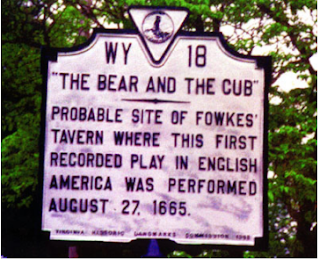
historical marker in Accomac, Virginia

For example, as a conversation starter I will sometimes ask: "When was the first play performed in the United States?" We discuss their answers, which they are allowed to guess or Google. I often get the following:
Then we consider that the United States has only been an name used for a particular area of North America since 1776. Of course, that geography has changed in the 245 since. We can then go further to consider what play may have been the "first" in the American colonies. But, then again, people have been on that land before the Colonies were formalized, even before the colonists reached the land. And we typically think of those colonies in the context of the 17th and 18th century. Did the Vikings perform plays in North America? In what ways did the indigenous peoples perform for one another?

It is a bit more than they bargained for, but in an elective class that the majority of students present didn't elect to take, it is an important idea to consider. Our definitions, our ideas about what is important or good or fact, may be limited by the context in which we search, or exist. It is a great way to get students who are used to thinking academically (not necessarily creatively) to realize that things can go in many different directions. That's an important understanding in a classroom where creativity and imagination are essential tools.

Sunday, January 2, 2022

Theatre History: Lincoln and Booth

Robert Todd Lincoln

One of my favorite stories from American theatre history is also connected to one of the most tragic. Last year, I included it in the discussion of theater and stage spaces in the middle school Theatre classroom. As I've previously written, that class is often populated with students who have been placed in the class rather than chosen it. Their interest in the art form is tepid, at best, so I love connecting it to other subjects whenever possible. The students' reactions to those connections are excellent.

This story may have taken place around this time of year in either late 1864 or early 1865 and involves the only surviving child of President Abraham Lincoln (Robert Todd Lincoln) and the older, more successful brother of his assassin, John Wilkes Booth (Edwin Booth). The story was told by Robert Lincoln to a friend in a letter dated many years after the event and goes something like this:
Edwin Booth as Hamlet

Robert Todd Lincoln was standing on a crowded train platform in Jersey City, NJ. He was pressed against a train that suddenly started moving. He lost his balance and slipped into the narrow opening between the train and the platform when someone grabbed him by the collar and pulled him to safety on the platform. Lincoln turned to thank the helper and found himself face to face with Edwin Booth, arguably the most famous actor in America at the time. Lincoln said he thanked Booth by name; however, it is not clear that Booth recognized Lincoln. At that time, Robert Todd Lincoln would have been about 22 or 23 years old and serving in the Union Army. He had not yet held any public office and presidential families were not as public and therefore not as recognizable as they would be today.

Obviously, Edwin Booth's youngest brother would murder President Lincoln just a few months later. Booth was devastated by this and it took him quite a while to return to the stage and the public. It is said that learning he saved the life of Robert Lincoln helped Edwin heal and feel a sense of redemption. It is also a remarkable coincidence and fantastic story!

Thursday, September 16, 2021

Who Killed Pinocchio?

Today in the TYA class at NYU, we will talk about one of my favorite moments in theatre history: the end of the Federal Theatre Project. The FTP, was a product of Roosevelt's New Deal that put visual and performing artists to work in a series of regional centers around the United States. The program included a series of performance units, as well, including the Children's Theatre Unit. The work produced in this unit was incredible. While the work included traditional adaptations of fairy tales, there were also some new works that explored news and issues of the day. It made the FTP an incubator for new work and new voices... which unfortunately was also the product of its demise in 1939.

The plays that seem to cause the most controversy were The Cradle Will Rock and Revolt of the Beavers, both produced in 1937. These plays explored the plight of workers and decried the greed and corruption that led to unfair working conditions in a steel town and fantasy world, respectively. This fueled anti-Communist sentiment within Congress who eventually defunded the entire Federal Theatre Project in 1939. Both plays are referenced in the 1999 movie, Cradle Will Rock, which serves as an excellent intro to the historic project through the lens of the production process for the titular play. Beavers is briefly mentioned in a scene where two actors dressed as beavers sing and dance for FTP director, Hallie Flannigan. Unfortunately, the movie makes light of the production, casting it off as a cute musical for kids, when in reality it may have been so upsetting to adults that it was the final nail in the coffin for the entire Federal Theatre Project (don't ever call theatre for young audiences "cute" again!).

To raise awareness of the program shutdown, the cast of the children's theatre unit production of Pinocchio in New York City, re-staged the final scene of the play on their closing night in December 1939. As I've heard the story told, the lights suddenly went out and a loud sound - a slam, a bang, or perhaps even a gunshot - rang out through the theatre followed by a funeral scene for the murdered Pinocchio. "Who killed Pinocchio?" the actors cry. In response, the cast reads a list of the names of Congress members who voted to defund the FTP. The cast then led the audience out into Times Square shouting "Save the Federal Theatre!" A Pinocchio puppet was left "dead" onstage in an icon image captured in Life magazine.

It's incredible to think of how widespread and influential the Federal Theatre Project was in its time. I'm also moved by how much a cute, little play for children was able to do. While the result wasn't positive, the incident serves as a strong example of just how power theatre for a child audience can be!

Friday, November 15, 2019

History & Theatre at 3rd & Chestnut

Had a great time Wednesday accompanying the 7th grade class on their field trip to the Museum of the American Revolution in Philadelphia today. I am a big history nerd, especially when it comes to the American Revolution. That period has been an interest of mine ever since I learned as a kid that I shared a birthday with George Washington. I am also fascinated by museums and libraries - I could spend all day getting lost in them reading, learning, dreaming... of course that wouldn't do on this trip. It was my job as chaperone to keep an eye on a group of 17 students as they were led around the museum by one of the education tour guides. It was the perfect opportunity to do what I ask my students in the TYA class at NYU to do: watch how the youth in the audience react to what is being presented and the students did not disappoint.

The museum uses a few techniques to gauge audience interest. The layout meanders through the second story of the building much like the snake depicted in the "Join or Die" drawing featured prominently on the wall in one of the first rooms on the tour. Each of the rooms is dimly lit - no doubt this is to protect the artifacts within, but it also serves to help illuminate the items, statues, and stories most important to the narrative of the museum. The students and I also received character cards that included the name and some basic background information about a real person who lived at the time of the Revolution. We were told by the guide that at the end it would be revealed whether or not the person on our card survived the war. It was a technique reminiscent of the passport given to visitors at the United States Holocaust Museum when I went many years ago.

There was at least one statue, or tableaux, present in the museum rooms depicting important steps on the road from Stamp Act to the Treaty of Paris. These seemed to capture the students' attention most, as did the various interactive touch screens in other locations. The figures were so close and so lifelike that I found that if I imagined enough, it almost seemed as if I was there in the moment. The most engaging part of the trip for the students seemed to come at two separate moments. First, we boarded a replica of the bow of a privateer's sloop where seven students were pressed into service to load and fire a cannon. They took the work seriously and were deeply engaged in the moment. It was unfortunate, however, that the rest of the tour group was disengaged. With four cannons on the ship, I wonder what it might take to get everyone involved in that activity. The second most engaging moment came at the end of the tour when students came face to face with photographs of the people listed on our cards (everybody's character survived). It was fascinating to watch as they eagerly sought out the picture with a name plate that matched the name on their card. Many were surprised by how the person looked in the portrait; the photographs were of the people in old age. The students also touched the photos as if to have a more personal connection through touch.

The final message from the tour guide was that the spirit of the Revolution continues on in America today as we constantly strive for a better life and society. It was a great message that was alluded to at least once or twice along the way. I find it empowering to leave an audience with a big question to think about after an experience like this; that is one of the great powers of theatre. Did it work in the museum setting? It did for me. How well it resonated with the students is something I would need to follow up on with them. We quickly left the gallery for lunch (an hour later than we typically eat at school), so thoughts quickly shifted from the revolution to our stomachs, I'm sure. That only emphasized the importance of a follow up event like a post-show discussion, or something else along those lines. My TYA class at NYU often advocates for these although I am often skeptical of how well they work.

Elizabeth "Mum Bett" Freeman
One other thing I enjoyed was that our tour guide took a moment to tell one of her favorite stories from the museum: that of Mum Bett, an enslaved woman from Massachusetts who successfully sued for her freedom under the Massachusetts Constitution in 1781. It set a prescident that allowed for other slaves to sue for their freedom and eventually led Massachusetts to become the first state to abolish slavery. Mum Bett, or Elizabeth Freeman as she was later known, was a topic of discussion during the TYA class at NYU yesterday as we discuss the play, The Judgement of Bett by R.N. Sandberg along with Harriet Jacobs a dramatization of Harriet Jacob's slave narrative adapted by Lydia R. Diamond. I love tying together theatre and history and was happy to have this connection on the tour. Looking forward to considering it again in class tomorrow; perhaps it is something that I can bring - at least in part - to the 7th graders, as well.