Wednesday, June 22, 2022
Moving the Blog
This summer, I'm trying something new and moving the posts from this blog and the Young Playwrights Guide to a new publication on Substack. The brand new Young Artists Guide premieres at 7:05 am today. Please take a look here. Thank you!

Tuesday, June 21, 2022
And... scene!
 |
| from the Holmdel Theatre Guild |
This year was a long one and like many other educators, I'm relieved to reach the end. This was a hard one. In some ways, this year was more difficult that the last two with Covid, but it ended on a relatively high note. Lots of yearbooks signed. A couple of student requests for selfies. A few gift cards. And one student who quietly asked me to sign her book and then, when I was finished, quickly told me I was one of her favorite teachers before she ran off and away from what was clearly a moment of vulnerability for her. As I told the two other students standing there with me, "that's why I like the last day of school".
Middle school graduation was last night and high school graduation is tonight. I view this last day in the same lens that many graduation speakers tend to take: Every end is a new beginning. There will be time to further reflect on the year and make adjustments for September. I have a pile of data from student surveys to peruse; oh, and a new classroom space being built! (More on that as we get closer). For now, I will try to take it easy. Maybe read a book, or play a game with my kids. There's so much more time for that now. The work will be there for me on Thursday.
Happy summer, everyone!
Wednesday, June 15, 2022
Remember to Have Fun

I try to keep the classroom fun. I'm lucky because theatre is built to be that way, but sometimes things can get a little too serious, or a little too formatted. Their display was a great reminder that sometimes we just need to let loose and have a good time... especially in school.
Sunday, June 12, 2022
Winding Down
 |
| Photo by Richard Pasquarella on Unsplash |
Seven days more until summer. June 21. Coincidentally, that is our last day of classes. I am especially looking forward to this one and to having time over summer for the preparation of new programming and to revise curriculum for 2022-2023.
These last days of school are always interesting. With middle school, it's about keeping things "normal" while battling the students' ever-growing feeling of summer freedom.
In the high school, there's more a sense of winding down. As tests and projects come due, we all breathe a bit easier and reflection takes the stage. I love sitting with classes and asking general questions: How are you? How did things go? What worked? What didn't? What would you like to see/do next time? What can we do better?
These conversations over the last five school days brought excellent ideas and suggestions from students that I can't wait to put into action. It's great how this work always comes back to the core finding that has become my mantra: "take them seriously". They've begun taking themselves seriously, too, and the awakening that has begun is going to be fun to watch develop in the next school year!
Saturday, April 30, 2022
We're Back!

Well, hello there! Long time, no see... and I'm just going to get this in before another month passes us by.
When I last left you, were we just getting into the thick of things with the high school musical. I'm happy to say that the experience was excellent and left us with positive vibes all around. I learned a lot from the experience and came away with some good data; I hope to write more about those things in the future.
For now, I'll say that the work begun in 2019 has successfully revitalized and grown our theatre program. Students are more engaged, families and faculty are excited, and there's all around good will toward our work. We've laid a solid foundation from which to grow and, yesterday, I received the gift of comfort being told that my contract will be renewed for next year. That's a huge weight off my shoulders! And, this is the first time in five years I've had that information before June. Now, we can turn attention toward next year with a confidence and certainty we've never had before.
In the meantime, I will return to school on Monday (after a surprise second bout with Covid right at the end of spring break) and the last two week of A Midsummer Night's Dream rehearsal at the middle school. I'm meeting wtih the musical collaborators to plan, not just for next year, but for two years at two schools. It's a great opportunity that I'm blessed to have. Can't wait to see what happens next!
Sunday, February 20, 2022
The Gifts of Planning & Collaboration
This school year presented a unique opportunity to direct plays on both sides of the MS/HS complex. At the end of January, we closed the middle school musical production of Rock of Ages: Youth Edition while the high school production of Oklahoma! was in full swing. Having collaborators on both projects made this a smoother transition than one might expect. I am grateful for their flexibility while I swung back and forth between the two projects.
It seems this arrangement may continue into next year with additional directing opportunities. It sounds like a lot of work (and it is), but an incredible way to further develop the theatre programs in both schools. An added benefit will be the time I've been given to plan.

Choose any number of quotes about the importance of planning here. The most difficult challenge in the process this year was being handed the reigns to the middle school shows a month into the school year. Again, having a collaborator made that process easier. The addition of time gives us the ability to reflect on this past process and to make adjustments for the year ahead. I already have a few ideas in mind and am excited by the possibilities.
It is a unique arrangement to be in charge of theatre programs at two schools. Perhaps some of you reading this post may have experience with this. Any suggestions or advice you may have are greatly appreciated!
Sunday, January 9, 2022
Theatre History: What was the "first" play in the United States?
My first year teaching middle school theatre, I was surprised by how few students understood that Theatre has ancient roots. In their defense, the history of theatre is not a major topic in elementary social studies classrooms, if it is even mentioned at all. It make sense that the students' frame of reference would be what they have experienced for themselves.
I love theatre history and it was a great pleasure to bring some of that knowledge to the curriculum in subsequent years. They are genuinely shocked by how old the art form is and how widespread the practice of performing stories for an audience has been across the world. What surprises them even more is that some historical "facts" can be disputed. This is particularly so when we talk about historical "firsts".
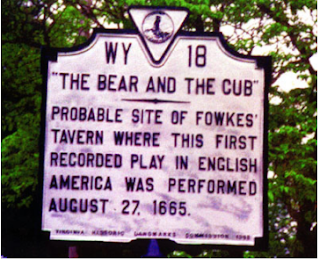 |
| historical marker in Accomac, Virginia |
Then we consider that the United States has only been an name used for a particular area of North America since 1776. Of course, that geography has changed in the 245 since. We can then go further to consider what play may have been the "first" in the American colonies. But, then again, people have been on that land before the Colonies were formalized, even before the colonists reached the land. And we typically think of those colonies in the context of the 17th and 18th century. Did the Vikings perform plays in North America? In what ways did the indigenous peoples perform for one another?
It is a bit more than they bargained for, but in an elective class that the majority of students present didn't elect to take, it is an important idea to consider. Our definitions, our ideas about what is important or good or fact, may be limited by the context in which we search, or exist. It is a great way to get students who are used to thinking academically (not necessarily creatively) to realize that things can go in many different directions. That's an important understanding in a classroom where creativity and imagination are essential tools.
Friday, January 7, 2022
Finding Purpose in the Pause

This morning I woke up to the second snow day of the week. While it is nice to have a more relaxed day at home, it also means rescheduling and restructuring lesson plans and rehearsal schedules and more, I'm sure. But in that re-, there's possibility. I will look at all of those plans with a new perspective and restructure goals under new limitations and dynamics. Being home also allows other opportunities, too (doing laundry while I work is huge).
From a more poetic viewpoint, there's possibility in a day like today - to any pause in our routine. I wrote more about it on the Young Playwrights Guide blog today. You can read that here.
Okay. Back to work!
Sunday, January 2, 2022
Theatre History: Lincoln and Booth
 |
| Robert Todd Lincoln |
This story may have taken place around this time of year in either late 1864 or early 1865 and involves the only surviving child of President Abraham Lincoln (Robert Todd Lincoln) and the older, more successful brother of his assassin, John Wilkes Booth (Edwin Booth). The story was told by Robert Lincoln to a friend in a letter dated many years after the event and goes something like this:
 |
| Edwin Booth as Hamlet |
Robert Todd Lincoln was standing on a crowded train platform in Jersey City, NJ. He was pressed against a train that suddenly started moving. He lost his balance and slipped into the narrow opening between the train and the platform when someone grabbed him by the collar and pulled him to safety on the platform. Lincoln turned to thank the helper and found himself face to face with Edwin Booth, arguably the most famous actor in America at the time. Lincoln said he thanked Booth by name; however, it is not clear that Booth recognized Lincoln. At that time, Robert Todd Lincoln would have been about 22 or 23 years old and serving in the Union Army. He had not yet held any public office and presidential families were not as public and therefore not as recognizable as they would be today.
Obviously, Edwin Booth's youngest brother would murder President Lincoln just a few months later. Booth was devastated by this and it took him quite a while to return to the stage and the public. It is said that learning he saved the life of Robert Lincoln helped Edwin heal and feel a sense of redemption. It is also a remarkable coincidence and fantastic story!
Friday, December 31, 2021
Goodbye, 2021

I'm also gearing up for the return to school on Monday, but not exactly sure what that day will bring. As my wife and I began our prep this evening, the biggest unknown is exactly who will be in the room. Her school has decided to go virtual for at least a week; mine has not made that call. I imagine we will be in-person, but I also expect that the room won't be full. Maybe we begin the week with a one-off SEL activity to ease us back into the groove and to assess who is there and how that week will go. Remote teaching is different from in-person teaching; a hybrid of both is yet another thing. Using the day to gauge will be of help.
Otherwise, the plan is to keep the students in mind and to continue "taking them seriously". Encourage their work, their ideas, and their voices and keep putting it into action. It has been a good adjustment bringing that idea to the fore. Doing it more should get them even more engaged than they already are.
Happy New Year, everyone! Make it a good one.
Friday, November 5, 2021
Welcome, November!

A few weeks ago, a text message spam bot from the NJEA wrote to ask if they'd see me at the convention this year. The reply was simple: "Nope!" All the best to those with the energy to get down to Atlantic City this weekend, but I need this time to myself. These first nine weeks of school are the toughest I've ever experienced and while I'm not in school, I am still working. There is plenty of grading and lesson planning and home projects that need attention.
And please check in on your teacher friends. Last year was hard, but this year is much harder. I won't be surprised if 2022 brings an even greater swath of retirements than we saw at the end of 2021.
Friday, October 15, 2021
Finding Fun
Last year was difficult. This year is harder. It's okay that I haven't posted in a month, but because I made the promise to myself that I would write a blog post every month this year, I'm determined to get one in. Yet, I am not going to write about education. At least not in the traditional sense. I'm quickly learning that sometimes a break is necessary. I've been finding ways to do that a little at a time during the weeks and am going to try and extend that here and change things up a bit.
This past spring, I accompanied my oldest son to a STEM event at the BSA troop that he wanted to - and ultimately did - join. The troop partnered with the Central NJ Rocketry Society (CENJARS) and the local HobbyTown shop to provide the scouts with the gear to build and launch model rockets. We had an awesome time and is a day we remember well. Not only was it fun to see my son launch a rocket that he built himself, but he also had the dubious honor of building the rocket that traveled furthest. - so far, in fact, that it landed about 20 feet up in a tree at the other end of a long field. One of the guys from CENJARS used a pole that extended just enough to retrieve the rocket.

We had so much fun that I checked out the hobby shop and learned that one of their specialties is Tamiya Mini 4WD slot cars. They have a good stock of car kits and parts and host a monthly race attended by a regular group of families and adults who thrive on a friendly and competitive race with 1/32 scale cars that they build at home. A kit costs about $12-17 dollars and run on AA batteries, so we figured it was worth trying once and encouraged all three kids to get involved. They love it so much that we've been there every month since. The kids have even placed in the top 3 a few times; the oldest won a new kit by placing first in his very first race! We even brought a group of our oldest's friends for the race on his birthday.
Not only do the kids love this, but I do, too. (I'd say "secretly", but no one in my house would be surprised to hear me say it). You can watch the video at this link to learn more about how building and racing works. It is unlike anything I've done before and has become an activity that we do together. Wins all around!
I'm writing about this because I haven't had a hobby in a very LONG time. I collected baseball cards as a kid and dabbled in a few scale models, but even then, I never considered myself a person with a hobby. In fact, I've come to realize that I viewed hobbies as something only children do and often claimed that I "didn't have time" for anything outside of work or raising small kids. And to some extent, that may be true. This is why I'm making note of it. In a year that is proving to be more challenging that most, after 18 months like we've never experienced before, it has been good to make time for fun and to do something completely unrelated to work. I am happy to have found this and even more happy that it was a result of doing something fun and challenging with my children. If you have the chance to find an activity that can do the same for you, I highly encourage it.
Have fun!
Thursday, September 16, 2021
Who Killed Pinocchio?
Today in the TYA class at NYU, we will talk about one of my favorite moments in theatre history: the end of the Federal Theatre Project. The FTP, was a product of Roosevelt's New Deal that put visual and performing artists to work in a series of regional centers around the United States. The program included a series of performance units, as well, including the Children's Theatre Unit. The work produced in this unit was incredible. While the work included traditional adaptations of fairy tales, there were also some new works that explored news and issues of the day. It made the FTP an incubator for new work and new voices... which unfortunately was also the product of its demise in 1939.


It's incredible to think of how widespread and influential the Federal Theatre Project was in its time. I'm also moved by how much a cute, little play for children was able to do. While the result wasn't positive, the incident serves as a strong example of just how power theatre for a child audience can be!
Saturday, September 4, 2021
End of Summer (or Expecting Another Shoe)
My summer ended this past Wednesday when I reported to school for the first of two professional development days. It was good to be back and I am excited by the prospects of another year with my students. However, there is a lingering, nagging sense that feels out of place for me - one that I can't quite put a name to. It isn't positive, but it also isn't completely negative. Maybe it is an internal warning not to get too excited.

Obviously, the last two years brought challenges that completely changed what I do, but we've also moved forward. I was thrilled to learn that my course load at the high school has increased to five Theatre classes (with 50 combined students). That's almost a 500% increase in students from the one class with 11 students in my first semester just two years ago. How we've been able to build a program through a pandemic is beyond me. Perhaps its just that we kept going?
Yet with that excitement there's also a dread that something else will pop up. It's like I'm looking over my shoulder expecting the next big disruption. Perhaps it is best to say I'm entering the year excited as always, but much less energized,... not a great feeling, but one that can bring growth. I know I'm not alone in these feelings and so I wish all the best for my fellow teachers this year. Hang in there!
Tuesday, August 17, 2021
Using Games to Teach Design
This past week, I led a summer camp at Monmouth County Parks that introduced the basic concepts of theatre design to students in grades 6-8. This is most definitely not my comfort zone as my design background is largely self-taught and I do not need to run any tech at school. However, I think there's something to the idea that one doesn't fully understand something until they can teach it and leading these camps has definitely taught me a lot.


Building from the experience last year, I incorporated a few changes into the program that worked well. The main change was moving away from a diorama-style build to one that would allow for a larger scale. The workshop encourages students to think more about scale and function that artistic skills, but working in the confines of a shoe box limited how things could work. This year, we used foam to create a base and backdrop on which the set would then be built. This allowed for a generous 1 inch: 1 foot scale and resulting set models that are easier to manipulate because they are bigger. Students who had chosen to build sets based in natural settings cut corners to not have to build such large trees and mountains. This produced great teachable moments when their "scale actors" suddenly dwarfed the trees! Theatre seems easy from the audience's perspective viewing the finished product - there's a LOT of work that goes into the planning and execution of what ends up on stage. You can see the students' models in the pictures included on this post.

I also picked up a valuable lesson that I will incorporate into my design unit at the middle school. I could tell that the campers were going to finish early on the last day and asked my wife, who is also a drama teacher (Instagram / TpT) for ideas of what I could do with them in the meantime. She suggested bringing in the board game Clue to play and to maybe incorporate into a final lesson on design. In the morning, I (re)introduced the game to the campers and instructed them to design one of the rooms from the game. I handed each of them cards from the Who, What, Where decks and encouraged them to build the room as they imaged it, but to incorporate elements (or clues) about the weapon and suspect into the drawing. They did this with subtle hints like color (for the suspect name), or a cutting board (for the knife), and in other ways. We played a modified game of Clue using those drawings, which didn't quite go as planned. Then we played the board game after. I think if I were to switch the order of those things, there might be an interesting and fun lesson about designing a location on stage. We'll see.

As fun as this camp was, I am glad that the summer camp sessions are over. As of this writing, there are 15 days until my first (PD) day at school. My wife and I are trying to use this week to do a number of family things with the kids before we need to really get serious about planning, prep, shopping, etc for whatever this school year has in store for us all!


Friday, August 6, 2021
Preparing for September: 5 Things I'm Doing

1) Revising Lesson Plans
Earlier this week, I got the first look at my class schedule and rosters for the upcoming year. There is an even split between my middle school and high school load that includes a course that I haven't taught yet. Additionally, the middle school curriculum is set up so that the procedure is the same, but the content rotates every year. This allows students to take the class in both 7th and 8th grades and to have the majority of the class work different each time.
This year, one of the performance projects in the middle school Theatre class will be Puppetry. The students in my first year loved this so much that I put it on hold last year, so that I could learn more to expand the curriculum and secure a grant from the Holmdel Foundation for Educational Excellence. I also want to thank Ms. Edna Bland for her expertise and guidance.
2) Incorporating more Games & SEL
If you have not participated in the #games4ed Twitter Chat, you may want to make plans to join in on Thursdays / 8 pm EST. This group of educators share examples and questions about incorporating games and puzzles into subject at every grade level. I've used some of the ideas presented here to build lessons and assessments that are more fun for students and for me.
3) Cleaning Up Social Media
It's no secret that I love social media. It has been a great way to communicate and gather information, but it gets messy. I find it helpful to sort through the accounts, update profiles, delete or rearrange any posts that may be necessary, and set up a preliminary post schedule. As someone mentioned in the comments of a post earlier this week, there are so many places to be online that it is important to pick just a few and focus there. I find it best to communicate with parents on Facebook, students on Instagram, and the rest of the world on Twitter. It is a lot to manage (I do this for the theatre program and the high school), but once you get into a groove, it works. My best advice would be to keep a schedule and use a platform like Hootsuite, Tweetdeck, or IFTTT to help. There are many others, too.
I also encourage you - whether in a school or organization - to balance your sales with interest stories. When I thought of how many times I block telemarketers, or unwanted ads, it just made sense.
4) Shopping
I am fortunate to have a small budget through school that covers basic classroom supplies. However, there are other things I will need to help me with management. Planners, dry erase markers, things like that. Oh, and clothes. It's amazing how quickly I can wear through my "teacher costumes"!
Also, you may want to set up an Amazon wish list for your classroom or department, if you don't already have one. There are times when someone may want to help, but you don't know exactly how. Purchasing an item from this list is a nice, simple way for community to get involved. And for any theatre teachers out there, connect with Dr. Jimmy Chrismon who runs the ThEDTalks Podcast. Not only are his interviews interesting, but he shares out teachers' wish lists each August.
5) Getting back into a routine... sort of
I've been teaching summer school and a few camp programs this summer. It helps keep me in practice and is a nice supplemental income when we're not receiving a regular paycheck (my wife is a teacher, too). It's still a summer schedule and I will beginning getting back into a groove of waking up early and going through the routines that get all of us out the door. I'm sure we would benefit from keeping a more regular routine during the summer, but we are a family of five and we're tired. It's been quite a year and using time to rest and recover has been well worth it.
PS - As I'm writing this, we are anticipating the announcement that New Jersey schools will be masked on the first day. It is an ever-changing situation... but isn't that how we would describe teaching anyway? What have you done to recover from the school year? What are you doing to prepare for September?
Thursday, August 5, 2021
Building Connection and Understanding

I realize that the tension is present in some schools and communities, but I believe it is time to move past that. If education is truly for the benefit of the whole child, then creating a culture (in school, at home, in the neighborhood, wherever...) where a student's participation in athletics, arts, and academics is paramount.
I am fortunate to be in a school district where that idea is a reality. There are great people in the athletic department and administrative chairs who see the value in what we do in the arts programs. I frequently connect with coaches to ensure students can be on stage and on a team. Many of those same students excel in Honors and AP level coursework, too. However, it takes work. It requires conversations and sacrifice and recognizing the common ground between us. In my school, we've done this through conversations (largely on social media, of all places) about leadership and coaching and the values we seek to instill in our students. (I've posted about my perspective on what school theatre is for here and here).
Whether you have the privilege to be in an environment like mine, or struggle in a place that does not see the value in arts education, I encourage you to reach out to community. Ask questions of stakeholders and detractors. Identify areas of common ground. Use your advocacy tools to demonstrate that value. Nothing is a panacea, but is a place to start.
I'm curious to hear from you. What are relationships like where you are? How can we work to build understanding and connection among programs, activities, and factions that are traditionally viewed as opposed to one another?
Wednesday, August 4, 2021
Advocacy is Storytelling
We talk a lot about advocacy in Arts Education. It is essential, but also can feel esoteric, or inaccessible. I've seen people recoil at the mention of it; the word has political undertones that some just don't want to touch.

I find it helps to think of advocacy as storytelling. The synonyms for the word seem to support that idea. After all, advocating for our work is simply supporting, championing, and (more simply) sharing what that work is and what it does.

I've found support in the blogs, books, and podcasts of people like Chase Jarvis, Seth Godin, and Dr. Brené Brown. Their suggestions to make a habit of the process of creating and sharing work, to "ship" the product, and to be "awkward, brave, and kind" have helped me formulate a direction for my advocacy. To me, theatre education provides the opportunity for students to create and perform, yes, but also to explore, experiment, interpret, collaborate, and develop a disciplined work ethic. Advocating these aspects meant documenting students' experiences in rehearsals, behind the scenes, and in between performances via social media, press releases, news articles, and email communications sent directly to the students, teachers, and parents within the school community. This opened up aspects of the work that our audience doesn't always see, or understand. We saw an increase in "outside" support (people volunteering their time and materials) and - although I don't have numbers to compare it to as we did not perform last year - I believe there was an increase in attendance during the performances. Seeing the students engaged in the process gave a tangible example of the importance of what we do in ways that my words just can't.
In summary, we encourage students to tell their stories through their artwork. As artists, educators, and organizations, it is important that we do the same by taking control of the narrative of what that work means. After all, if we don't tell our story the way we want it to be told, someone else will surely tell it in their own way.
How do you advocate for your work in arts education? Please share your ideas in comments, or engage with me on social media. I look forward to hearing from you!
Tuesday, August 3, 2021
Thinking Digitally
When school went virtual last March, our winter musical performance was put in hold. This happened everywhere, of course, but we were hit especially hard because the call to postpone came just minutes before the end of the school day - just 3 hours before students would return for hair & make-up on opening night. The experience resulted in an incredible story of resiliency starring my students, but that's for another time.
Without a live event, and the uncertainty of what lay ahead, the creative team began exploring options to showcase the students' work in another way. We considered a scaled-back concert, outdoor performances, and inevitably some kind of stripped-down streaming presentation. Circumstances kept changing and, unfortunately, we ran out of time. The show was cancelled and in deference to the seniors, we decided not to repeat the show again the following year. One thing haunted me throughout the experience - if we had just recorded one dress rehearsal, we could have worked with the licensing company to present it online. Lesson learned. I would not make that mistake again.

This past winter, we forged ahead with the goal of a live performance, but with digital/streaming as a backup plan. I recorded something at least once every week as a way to document what we were doing behind the scenes and to get the audience acclimated to watching online... just in case.
We had plenty working against us, both Covid and non-Covid related. Eventually, the decision was made to film the show and stream online. The final two weeks were a unique experience that none of us will forget. While the result wasn't we wanted, streaming the show had plenty of positives. For one, we were able to have a show where we couldn't last year and likely wouldn't under the circumstances we faced. Also, being online expanded our audience beyond the doors of the auditorium to reach far away relatives, friends, and other theatre people who would not have seen the show live. Plus, the students had the unique experience of watching their performances "in real time".
On September 13, we will be 18 months removed from the first day of Covid quarantine. That is a long time to endure without an art program and I saw our survival in the push to keep doing something. In the professional field-at-large, there are organizations who found ways to continue producing their work digitally while others have struggled to survive. I get it. Theatre is live performance and doesn't always translate well to the screen (an irony that my middle school students pointed out when we were virtual), but surely that is better than nothing.
I've seen concern from some theatre artists via Twitter that some organizations and communities are moving away from digital presentation as buildings begin to open up again. It is surprising to see that given how successfully companies like the National Theatre in London, among others, had done so. I realize that the collaborative nature of theatre and the copyrights, licenses, contracts, and other elements provide a hurdle as currently constructed. Surely, with digital technology so prevalent and easy to access we should continue to explore ways to not only make the art accessible during times of inaccessibility, but more equitable, too.
PS - My assumption is that visual artists and organizations fared better during quarantine as digital is inherently visual. The art teacher at my school did an excellent job getting her students' work out online even though there was a large learning curve for her to do so). However, that is not my field and I really don't know the realities of the visual art world and would love to hear from some of you about that!
Monday, August 2, 2021
Social Media Take-Over for Arts Ed NJ

It's been a busy couple of weeks for me and there's a lot on my mind. Just 30 days to the first in-service for me, which means I will spend more time focused on school prep this month. There are a few things in particular that I'm eager to explore. This week (August 2-6), I will touch on some of them during a social media takeover of the
Arts Ed NJ accounts. Come join the conversation!
Subscribe to:
Posts (Atom)